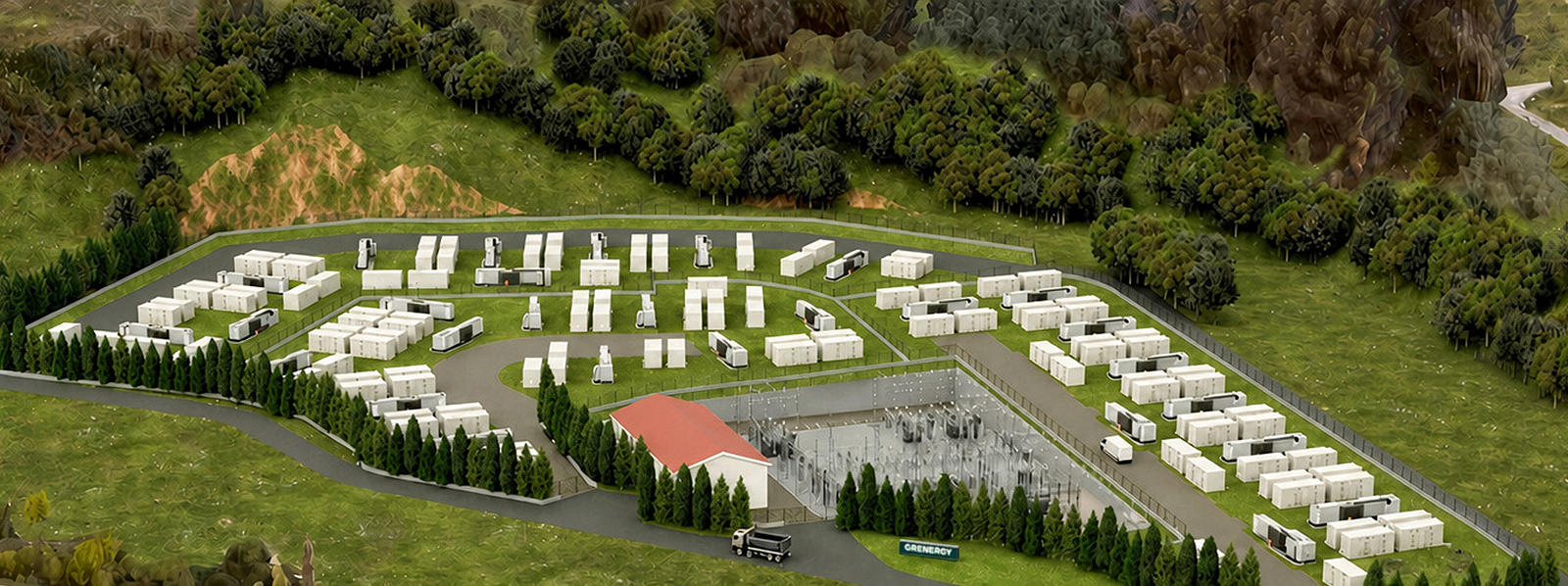
Oviedo

Greenbox, our stand-alone battery platform in Europe.

With a total pipeline exceeding 30 GWh, it is rapidly establishing itself as one of the largest storage platforms on the continent.

We are advancing strategic projects across six key European markets: Romania (7 GWh), Spain (6 GWh), Italy (5.8 GWh), Poland (5 GWh), the United Kingdom (4 GWh), and Germany (3 GWh).

Systems like Greenbox are key to modernizing the grid. They allow energy to be stored during generation peaks and released when demand increases, reducing volatility and ensuring system stability.

Play video

Headquarters

Calle de Rafael Botí 26, 28023, Madrid, Spain

40°28`N 3°48´W

Our flagship stand-alone battery project located in Spain.

Oviedo

Built on a former industrial site in La Corredoria, it features a power output of 154 MW and 618 MWh of capacity (equivalent to 4 hours of storage).

A project backed by the first 10‑year Tolling Agreement in the Spanish market with an international utility, and by the first financing for a stand‑alone battery energy storage project in Spain worth €100 million.

With this and future projects, Spain positions itself as the strategic engine for our growth in Europe.

Stand-alone projects like Oviedo provide instant flexibility to the grid, ensuring frequency stability and mitigating price volatility. The project is expected to enter into operation during the first half of 2027.

Energy storage facilities need to be located close to the electrical substation to which they are connected. In this case, the project will be located next to the Corredoria substation, allowing for a short, fully underground grid connection and reducing the need for new infrastructure.

The selected site is a former quarry located on industrial land, adjacent to a disused factory and the AS-II motorway. After assessing different alternatives, this location was identified as the option with the lowest environmental, territorial and landscape impact.

The project will use lithium iron phosphate (LFP) batteries, one of the most widely used technologies for energy storage due to their high thermal stability.

The facility will be equipped with control systems that continuously monitor the batteries’ temperature, voltage, current and state of charge. If any anomaly is detected, the protection systems are automatically activated.

No. The cooling system operates in a closed loop, so it does not require a continuous water supply.

Water consumption will be minimal and limited to auxiliary and service uses.

Before the project was designed, an acoustic study was carried out taking into account the existing conditions of the surrounding area, where the main sources of noise are traffic from the AS-II motorway and the railway.

The study concludes that the facility will comply with all applicable regulatory noise limits. The noise generated comes mainly from the ventilation systems and is of low intensity.

Like any electrical installation, some equipment generates electric and magnetic fields during operation.

Regulations establish exposure limits of 5 kV/m for electric fields and 100 µT for magnetic fields. The studies carried out confirm that all project equipment will operate within these limits.

Safety has been one of the key criteria throughout the project design.

Each battery container operates as an independent unit and is physically separated from the others to prevent any potential incident from spreading.

In addition, each container incorporates smoke, temperature and gas detection systems, automatic disconnection systems, and a dedicated fire suppression system specifically designed for battery installations, which operates inside the container without using water as its primary extinguishing agent.

The facility will also include access roads designed for emergency services, a connection to the municipal water network, and a perimeter road along the northern boundary as an additional wildfire protection measure.

Before the facility enters into operation, the corresponding Emergency Response and Self-Protection Plan will be submitted to the Oviedo Fire Brigade and Civil Protection authorities.

The project includes specific measures to protect the soil, properly manage stormwater runoff and drainage systems, and prevent accidental spills.

Any waste and substances requiring special treatment will be stored and managed by authorised operators in accordance with current regulations.

The project includes a dedicated landscape integration study aimed at minimising its visual impact.

Measures include the creation of vegetative screening through tree planting, the preservation of existing vegetation that already helps integrate the facility into its surroundings, and ongoing monitoring of the establishment and growth of the new planting.

The project will contribute to the local economy through the payment of the applicable taxes, including the Construction, Installations and Works Tax (ICIO), the Special Characteristics Property Tax (BICES) and the Economic Activities Tax (IAE).

During construction, the project will generate work for civil engineering contractors, installation and assembly companies, transport providers and auxiliary service businesses.

Where market conditions allow, Grenergy will prioritise the use of local suppliers and has channelled recruitment through the Employment Agency of Oviedo City Council.

Once operational, the facility will require maintenance, monitoring and security services.

Yes. Grenergy will work together with the City Council and other local stakeholders to identify voluntary initiatives that address the municipality’s needs and priorities.

Specific initiatives will be announced once the relevant agreements have been reached.

If you have any questions or would like further information about the project, please contact us at [email protected].

Oasis de Atacama

View project

Atacama Desert

23°52`S 69°8´W

Operating since

2024

Hybridization

Your questions are always welcome

Loading...
Attach file if you need it
PDF or Microsoft Word file format of maximum 8M.